Showing posts with label out of africa. Show all posts

Thursday, November 17, 2011

Out of India after Africa? Nat Geo now supports this theory

"Modern humans migrated out of Africa via a southern route through Arabia, rather than a northern route by way of Egypt, according to research announced at a conference at the National Geographic Society this week.

“Evolutionary history shows that human populations likely originated in Africa, and the Genographic Project, the most extensive survey of human population genetic data to date, suggests where they went next…Modern humans migrated out of Africa via a southern route through Arabia, rather than a northern route by way of Egypt,” said a news statement released by IBM."


“The divergence of a common genetic history between populations showed that Eurasian groups were more similar to populations from southern India, than they were to those in Africa. This supports a southern route of migration from Africa via the Bab-el-Mandeb Strait in Arabia before any movement heading north, and suggests a special role for south Asia in the ‘out of Africa’ expansion of modern humans.”

Full Story 

Other links:

Genographic Project confirms humans migrated from Africa through Arabia 


Monday, June 28, 2010

Facts and Common Misconceptions

  • No, haplogroups are not the same as haplotypes.
  • Yes, all people living today fall into one of 18 main Y-DNA haplogroups on their paternal line, and one of 26 main mtDNA haplogroups on their maternal line.
  • No, haplogroups will not show if you are related to someone (unless you count distant relationships from thousands of years ago).
  • Yes, once you know your haplogroup, you will be able to view how your haplogroup migrated out of Africa and retrace their migration routes.
  • No, haplogroups will not add people to your family tree or allow you to trace your surname (that’s the job of STR haplotypes).
  • No, haplogroups will not tell you precise migration routes, it will show a broad migration route and population distribution.
  • No, if you and someone else belong to the same haplogroup, it does not mean that you are closely related.
  • Yes, once you know your haplogroup, you can often fine tune your branch of the haplogroup tree through subclade testing.
  • No, you cannot confirm your haplogroup through STR testing or HVR1 testing.  A Y-DNA STR test and HVR1 test will often allow you to predict your haplogroup, but only a SNP backbone test will confirm the prediction.
  • No, SNP backbone testing will not give you information about sub-clades.  It will confirm your haplogroup.  Once your haplogroup has been confirmed, a subclade panel test for your particular haplogroup will trace your subclade. 
  • Yes, STR testing can give predictions for haplogroups and even some sub-clades, but the backbone test can only confirm the haplogroup, not the sub-clade.
  • Yes, subclades are determined through SNP subclade testing (once your haplogroup has been confirmed)
  • No, your haplogroup will not tell you if you are Welsh or Irish.  It will not tell you your ethnicity.  Although there are associations between ethnic groups and haplogroups, you must remember that haplogroups represent deep ancestry, tracing events from tens of thousands of years ago.  It does not tell you what your ancestors have been up to over the last few hundred years (that’s the job of Y-DNA STR markers, and applications such as Surname Projects, which will be the topic of another blog). 
  • Yes, all people living in the world today are connected in the human phylogenetic tree.  Just like how all people belong to a certain blood group i.e. A, B, AB, O which can be determined through testing, all people also belong to a certain haplogroup which is unique to their ancestry, and their haplogroup type can be determined through genetic genealogy testing. 
From Genebase.com

    Tuesday, February 23, 2010

    Phylogenetic tree of human Y-chromosome haplogroups observed in Eurasians

     
    click to enlarge
    A couple of things I notice on the chart:
    1. R2 is shown as younger than R1/R1a/R1b, which I think is probably true.
    2. An Asian source for all Europeans - excluding haplogroup E.
    link

      The Human Genetic History of South Asia

      Partha P. Majumder

      Summary:

      South Asia — comprising India, Pakistan, countries in the sub-Himalayan region and Myanmar — was one of the first geographical regions to have been peopled by modern humans. This region has served as a major route of dispersal to other geographical regions, including southeast Asia. The Indian society comprises tribal, ranked caste, and other populations that are largely endogamous. As a result of evolutionary antiquity and endogamy, populations of India show high genetic differentiation and extensive structuring. Linguistic differences of populations provide the best explanation of genetic differences observed in this region of the world. Within India, consistent with social history, extant populations inhabiting northern regions show closer affinities with Indo-European speaking populations of central Asia that those inhabiting southern regions. Extant southern Indian populations may have been derived from early colonizers arriving from Africa along the southern exit route. The higher-ranked caste populations, who were the torch-bearers of Hindu rituals, show closer affinities with central Asian, Indo-European speaking, populations.

      Current Biology, Volume 20, Issue 4, R184-R187, 23 February 2010
      Full article (link)

      Saturday, December 12, 2009

      Asia populated in one migratory swoop

      By David Cyranoski

      Researchers mapping a massive array of genomes across Asia say they have found evidence that humans covered the continent in a single migratory wave, and share a common ancestry.

      The findings were released by the Human Genome Organisation (HUGO) Pan-Asian SNP Consortium which looks at single-nucleotide polymorphisms (SNPs), or variations at individual bases that make up the genetic code. The results challenge the view that Asia was populated by at least two waves of migration.

      "In Asia, we are all related," says Edison Liu, a lead author from the Genome Institute of Singapore. "It brings us closer together."

      It is thought that a wave of humans emerged from Africa some 60,000-75,000 years ago and travelled along the southern coast of India, into southeast Asia and down to Oceania. But scientists struggled to explain some of the variation seen in Asia today - such as the obvious physical differences between Malaysian and Filipino Negrito populations and other Asians. Some researchers have postulated that a second wave, or series of waves, from a northern route largely repopulated the area, leaving the Negrito and others as relicts of the earlier migration.

      The new study, a five-year examination of variation at some 55,000 SNPs in 1928 individuals, found that Negrito populations had a high level of genetic overlap with other southeast Asia populations, suggesting a common ancestry. East Asians, the analysis suggests, share a large degree of common genetic background with southeast Asians but very little with central Asians, seeming to preclude a peopling of east Asia through a northern route via the Eurasian Steppes. And genetic variation within local populations decreased from southeast to northeast Asia. The two observations suggest that diverse peoples living in southeast Asia migrated northwards.

      "It's an impressive collection of samples, a huge amount of work and analysis, and it will contribute greatly to the field," says Mark Stoneking, an evolutionary geneticist at Max Planck Institute for Evolutionary Anthropology in Leipzig, Germany, who was not involved in the study.

      Asian unity

      Merely organizing the work was a massive task. Researchers in 11 countries and regions took samples from 73 populations, requiring countries often at political or economic loggerheads to share ideas, technology and genomes. For countries lacking the technological capabilities to do the genetic analysis but loath to ship genetic samples to another country, Liu established a system by which researchers could bring the samples to host countries and do the studies themselves, in collaboration with their hosts. "The chain of custody was never broken," he says. "It was extraordinarily collegial."

      The result is not a complete shock. While this study provides the most detailed analysis of genetic diversity among Asians to date, a 2005 study on mitochondrial DNA came to a similar conclusion2. Martin Richards, at the University of Leeds, UK, is a specialist in genetic variation in southeast Asia who led that study. "By and large, [the new study] is not surprising for fans of mitochondrial DNA, I think, but naturally it is very heart-warming," he says.

      The new study also supports mitochondrial DNA evidence that challenges the customary "out of Taiwan" model, in which migration from mainland China through Taiwan led to the settlement of southeast Asia and the Pacific islands. Instead it seems Taiwan may have been largely settled from islands in southeast Asia.

      But the results are not conclusive, as the authors admit. Stoneking says he was "very surprised that the Negrito populations were not more genetically distinct", and would like to see other supposed relict populations, such as those in New Guinea and Australia, studied in the same kind of detail. He argues that it is not possible to tell whether extensive genetic intermingling with surrounding populations might have obscured evidence for two waves of migration. He says he has evidence to support the two-wave theory in work yet to be published that looks specifically at mitochondrial DNA and Y-chromosomes of Negrito populations.

      Liu says he is discussing plans for a second phase study with much higher resolution - based on 600,000-1 million SNPs. Possible extensions for the new project will be a look at copy number variation (duplications in sections of DNA), a resequencing of mitochondrial DNA and a focus on specific genetic components such as differences between enzymes that metabolize drugs, and human leukocyte antigen variations. It will be especially tantalizing, says Liu, to see if drug-metabolism genes show the same north-south variation in east Asia. "There would be implications for drug response and clinical trials," he says - although he adds that it will not be possible to link specific health information to genotypes across the continent.

      Asia populated in one migratory swoop - SciAm
      http://www.sciencemag.org/cgi/content/abstract/326/5959/1541
       

      HUGO study reveals India as the source of Asian genetic diversity

      By: ASHOK B SHARMA


      A study done by a consortium of geneticists from 10 Asian countries shows that Indian genetic diversity is the basis of other population in Asia. It says that over 50,000 years ago there was a first single stream entry of humans into India from Africa. From India the human population settled in South-East Asia and from there some of then moved to east and central Asia.

      The study tends to refute the age old belief that Aryans as a distinct race who migrated from Central Asia and settled in the plains of north India. If we are believe the origin of humankind in Africa and the first outward stream of humans settling in India and thereafter spreading to other parts of Asia, including Central Asia, then they are same people who might have probably come back and resettled in India from Central Asia However, HUGO has planned to undertake further studies including Central Asia and the Polynesian Islands.

      The first ever study of human genomes of Asia conducted by Human Genome Organisation (HUGO) Pan-Asian SNP Consortium also says that some of the Indian population showed evidence of shared ancestry with European population and this is consistent with the expansion of Indo-European speaking population.

      This HUGO’s Pan-Asian initiative is a consortium of 90 geneticists and 40 institutions from 10 Asian nations, namely China, India, Indonesia, Japan, Malaysia, Philippines, Singapore, South Korea, Taiwan and Thailand. It collected samples from 1,928 unrelated individuals representing 73 groups of people from 10 countries and 10 linguistic lineages from member countries as well as from two non-Asian population groups of Africo-American and Caucasian ancestry.

      HUGO Pan-Asia SNP Consortium study has been recently published the reputed  Science magazine (vol 326) in December 11, 2009 According to the study modern humans evolved in Africa and spread across the world, adapting locally to the selective pressures of climate, food sources and pahogens.

      'Tracking genetic variations through human migrations provides clues to evolution of diseases and phenotypes. India can be a crucible for clinical trials of medicines suitable for Asian population,' said Prof Samir Brahmachari, director-general of the apex Indian scientific body, Council of Scientific and Industrial Research (CSIR). Alongwith Prof Brahmachari, Dr Mitali Mukherjee of Institute of Genomics and Integrative Biology  and Dr Partha P Majumdar, head of the human genetics unit of Indian Statistical Institute were represented in the consortium from India.

      According to the study the most recent common ancestors of Asians arrived first in India. Later some of them migrated to Thailand and southwards to the land known today as Malaysia, Indonesia and also eastwards to the Philippines. The first group of settlers must have gone very far south before they settled successfully. These includes the Malay Negritos, Philippine Negritos, the East Indonesians and early settlers of the Pacific Islands. Thereafter one or several groups of people migrated North, mixed with previous settlers there and finally formed various population groups we now refer to as Austronesian, Austro-Astiatic, Tai-Kadal, Hmong-Mien and Altaic.

      'This study is a milestone not only in the science that emerged, but the consortium that was formed. Ten Asian countries came together in the spirit of solidarity to understand how we related as a people and we finished with a truly Asian scientific community. We overcame shortage of funds and diverse operational constraints through partnerships, good will and cultural sensitivity,' said Prof Edison Liu, executive director Genome Institute of Singapore and President of the HUGO.

      The study also reveals that more than 90% of East Asian haplotypes are found in either South-East Asian or Central-South Asian population and shows clinical structure with haplotype diversity decreasing from south to north. Furthermore, 50% of East Asian haplotypes were found in South-East Asia only and 5% were found in Centra-South Asia only, indicating that South-East Asia was a major geographic source of East Asia population.

      India has recently achieved a major breakthrough in human genome sequencing. Scientists at CSIR’s affiliate organization, Institute of Genomics and Integrative Biology (IGIB)  sequenced the human genome of an anonymous Indian citizen. The human genome has 3.1 billion basepairs The team at IGIB generated over 51 gigabases of data using next generation sequencing technology, resulting in over 13x coverage of the human genome. This next generation sequencing technology used in this case enables massively parallel sequencing of millions of genomic fragments of 76 base pairs which are then mapped back to the reference genome. This humongous exercise was made possible with the CSIR supercomputing facility at IGIB.

      Sequencing of a human genome requires high computational capability and technological know-how in handling sophisticated machines and analyzing huge volume of data. The first human genome sequencing initiative was conceived as early as 1984. In addition to the US, the international human genome project consortium comprised geneticists from UK, France, Germany, Japan and China. This project formally started in 1980 and sequencing was completed in 2003. India then could not be a part of the process due to lack of resources. Currently more than 14 human genomes sequences from different countries have been announced globally. With the completion of its first first human genome sequence, India is now in the league with few select countries like the US, UK, China, Canada and South Korea.

      Link

      Friday, November 20, 2009

      Y chromosome diversity, human expansion, drift, and cultural evolution

      Jacques Chiaroni,
      Peter A. Underhill and
      Luca L. Cavalli-Sforza
      17 Nov, 2009

      Abstract:

      The relative importance of the roles of adaptation and chance in determining genetic diversity and evolution has received attention in the last 50 years, but our understanding is still incomplete. All statements about the relative effects of evolutionary factors, especially drift, need confirmation by strong demographic observations, some of which are easier to obtain in a species like ours. Earlier quantitative studies on a variety of data have shown that the amount of genetic differentiation in living human populations indicates that the role of positive (or directional) selection is modest. We observe geographic peculiarities with some Y chromosome mutants, most probably due to a drift-related phenomenon called the surfing effect. We also compare the overall genetic diversity in Y chromosome DNA data with that of other chromosomes and their expectations under drift and natural selection, as well as the rate of fall of diversity within populations known as the serial founder effect during the recent “Out of Africa” expansion of modern humans to the whole world. All these observations are difficult to explain without accepting a major relative role for drift in the course of human expansions. The increasing role of human creativity and the fast diffusion of inventions seem to have favored cultural solutions for many of the problems encountered in the expansion. We suggest that cultural evolution has been subrogating biologic evolution in providing natural selection advantages and reducing our dependence on genetic mutations, especially in the last phase of transition from food collection to food production.


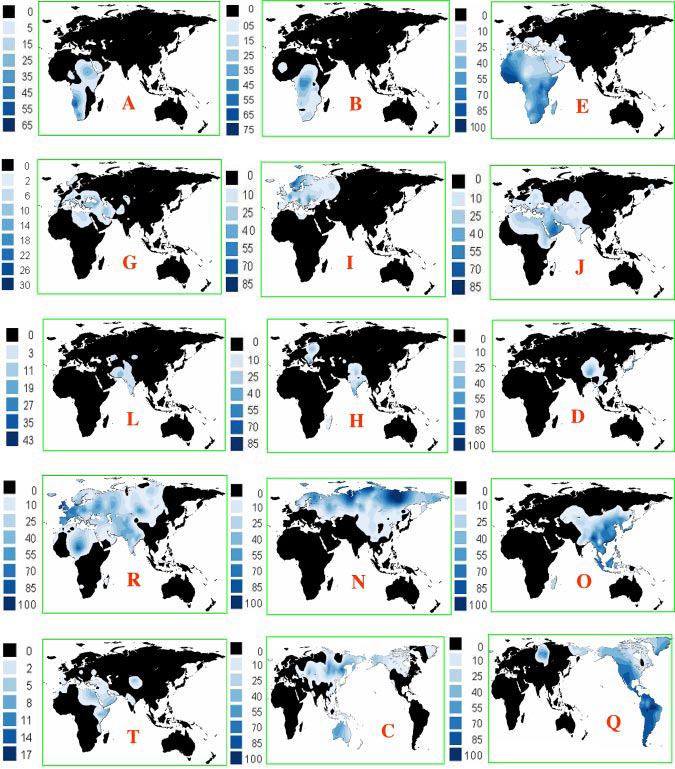
      Y chromosome haplogroup geographical distribution map
       
       
      Phylogenetic relationships of the 20 major Y chromosome haplogroups


      Haplogroup R and subclades frequency distribution


      Link