
Partha P. Majumder
Summary:
South Asia — comprising India, Pakistan, countries in the sub-Himalayan region and Myanmar — was one of the first geographical regions to have been peopled by modern humans. This region has served as a major route of dispersal to other geographical regions, including southeast Asia. The Indian society comprises tribal, ranked caste, and other populations that are largely endogamous. As a result of evolutionary antiquity and endogamy, populations of India show high genetic differentiation and extensive structuring. Linguistic differences of populations provide the best explanation of genetic differences observed in this region of the world. Within India, consistent with social history, extant populations inhabiting northern regions show closer affinities with Indo-European speaking populations of central Asia that those inhabiting southern regions. Extant southern Indian populations may have been derived from early colonizers arriving from Africa along the southern exit route. The higher-ranked caste populations, who were the torch-bearers of Hindu rituals, show closer affinities with central Asian, Indo-European speaking, populations.
Current Biology, Volume 20, Issue 4, R184-R187, 23 February 2010
Full article (link)
Showing posts with label human evolution. Show all posts
Showing posts with label human evolution. Show all posts
Tuesday, February 23, 2010

Friday, November 20, 2009
Y chromosome diversity, human expansion, drift, and cultural evolution
Jacques Chiaroni,
Peter A. Underhill and
Luca L. Cavalli-Sforza
17 Nov, 2009
Abstract:
The relative importance of the roles of adaptation and chance in determining genetic diversity and evolution has received attention in the last 50 years, but our understanding is still incomplete. All statements about the relative effects of evolutionary factors, especially drift, need confirmation by strong demographic observations, some of which are easier to obtain in a species like ours. Earlier quantitative studies on a variety of data have shown that the amount of genetic differentiation in living human populations indicates that the role of positive (or directional) selection is modest. We observe geographic peculiarities with some Y chromosome mutants, most probably due to a drift-related phenomenon called the surfing effect. We also compare the overall genetic diversity in Y chromosome DNA data with that of other chromosomes and their expectations under drift and natural selection, as well as the rate of fall of diversity within populations known as the serial founder effect during the recent “Out of Africa” expansion of modern humans to the whole world. All these observations are difficult to explain without accepting a major relative role for drift in the course of human expansions. The increasing role of human creativity and the fast diffusion of inventions seem to have favored cultural solutions for many of the problems encountered in the expansion. We suggest that cultural evolution has been subrogating biologic evolution in providing natural selection advantages and reducing our dependence on genetic mutations, especially in the last phase of transition from food collection to food production.


Link
Peter A. Underhill and
Luca L. Cavalli-Sforza
17 Nov, 2009
Abstract:
The relative importance of the roles of adaptation and chance in determining genetic diversity and evolution has received attention in the last 50 years, but our understanding is still incomplete. All statements about the relative effects of evolutionary factors, especially drift, need confirmation by strong demographic observations, some of which are easier to obtain in a species like ours. Earlier quantitative studies on a variety of data have shown that the amount of genetic differentiation in living human populations indicates that the role of positive (or directional) selection is modest. We observe geographic peculiarities with some Y chromosome mutants, most probably due to a drift-related phenomenon called the surfing effect. We also compare the overall genetic diversity in Y chromosome DNA data with that of other chromosomes and their expectations under drift and natural selection, as well as the rate of fall of diversity within populations known as the serial founder effect during the recent “Out of Africa” expansion of modern humans to the whole world. All these observations are difficult to explain without accepting a major relative role for drift in the course of human expansions. The increasing role of human creativity and the fast diffusion of inventions seem to have favored cultural solutions for many of the problems encountered in the expansion. We suggest that cultural evolution has been subrogating biologic evolution in providing natural selection advantages and reducing our dependence on genetic mutations, especially in the last phase of transition from food collection to food production.
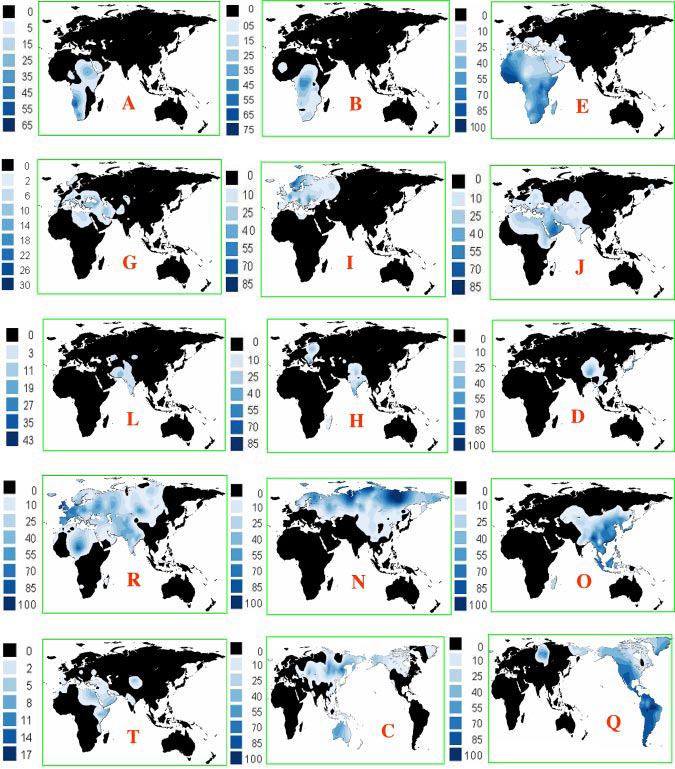
Y chromosome haplogroup geographical distribution map

Phylogenetic relationships of the 20 major Y chromosome haplogroups

Haplogroup R and subclades frequency distribution

Link
Monday, November 9, 2009
Parsis show closer affinity to low caste Mahars and tribal Madia Gonds than South and Central Asian groups
Population affinities of Parsis in the Indian subcontinent
International Journal of Osteoarchaeology doi:10.1002/oa.1123
Manjari Jonnalagadda et al.
Abstract
The present study was an attempt to document changes in frequencies of dental morphology traits and understand phenetic affinities of Parsis, who migrated to the Indian subcontinent around the 8th century. Despite successfully integrating themselves into the Indian society, they have retained their ethnicity and distinct cultural practices. This study was conceived as a result of an excavation at the site of Sanjan, Gujarat which, as per historical records, is believed to be the first town in the Indian subcontinent with a large Parsi settlement thereby facilitating a diachronic comparison between the ancestral and extant Parsi groups. We compared and analysed dental traits between the two groups expecting a very close relationship between them owing to their ancestor-descendent relationship. Eleven discrete dental traits were selected and scored using the Arizona State University Dental Anthropology System (ASUDAS). Frequency changes were assessed by comparing trait frequencies; whereas phenetic affinity between Parsis was assessed by statistically comparing them with 13 populations using Smith's mean measure of divergence (MMD) statistic. Comparison of dental trait frequencies between Sanjan and extant Parsi samples show significant differences in incisor morphology, Carabelli cusp and Hypocone development. Trait frequencies, MMD values and 2D multidimensional scaling (MDS) plot indicate that extant Parsis and Sanjan samples are distantly separated from each other. Extant Parsis show closer affinity to low caste Mahars and tribal Madia Gonds than South and Central Asian groups. Sanjan is distant from all other groups including extant Parsis. It is likely that genetic drift accentuated by their small numbers and strict endogamy has resulted in divergence of Parsi groups. Similarly, their convergence with Maharashtran groups indicates admixture of Parsis with local groups, which supports earlier conducted mtDNA studies.
Link
International Journal of Osteoarchaeology doi:10.1002/oa.1123
Manjari Jonnalagadda et al.
Abstract
The present study was an attempt to document changes in frequencies of dental morphology traits and understand phenetic affinities of Parsis, who migrated to the Indian subcontinent around the 8th century. Despite successfully integrating themselves into the Indian society, they have retained their ethnicity and distinct cultural practices. This study was conceived as a result of an excavation at the site of Sanjan, Gujarat which, as per historical records, is believed to be the first town in the Indian subcontinent with a large Parsi settlement thereby facilitating a diachronic comparison between the ancestral and extant Parsi groups. We compared and analysed dental traits between the two groups expecting a very close relationship between them owing to their ancestor-descendent relationship. Eleven discrete dental traits were selected and scored using the Arizona State University Dental Anthropology System (ASUDAS). Frequency changes were assessed by comparing trait frequencies; whereas phenetic affinity between Parsis was assessed by statistically comparing them with 13 populations using Smith's mean measure of divergence (MMD) statistic. Comparison of dental trait frequencies between Sanjan and extant Parsi samples show significant differences in incisor morphology, Carabelli cusp and Hypocone development. Trait frequencies, MMD values and 2D multidimensional scaling (MDS) plot indicate that extant Parsis and Sanjan samples are distantly separated from each other. Extant Parsis show closer affinity to low caste Mahars and tribal Madia Gonds than South and Central Asian groups. Sanjan is distant from all other groups including extant Parsis. It is likely that genetic drift accentuated by their small numbers and strict endogamy has resulted in divergence of Parsi groups. Similarly, their convergence with Maharashtran groups indicates admixture of Parsis with local groups, which supports earlier conducted mtDNA studies.
Link
Wednesday, November 4, 2009
New study on Haplogroup R1a
This study speaks against substantial gene flow from Eastern Europe since the mid holocene(1000 to 3000 years earlier than the purported time of the mythical Aryan Invasion of India):
"the virtual absence of M458 chromosomes outside Europe speaks against substantial patrilineal gene flow from East Europe to Asia, including to India, at least since the mid-Holocene. "
Separating the post-Glacial coancestry of European and Asian Y chromosomes within haplogroup R1a
Underhill et al. - Nov 2009
Abstract:
Human Y-chromosome haplogroup structure is largely circumscribed by continental boundaries. One notable exception to this general pattern is the young haplogroup R1a that exhibits post-Glacial coalescent times and relates the paternal ancestry of more than 10% of men in a wide geographic area extending from South Asia to Central East Europe and South Siberia. Its origin and dispersal patterns are poorly understood as no marker has yet been described that would distinguish European R1a chromosomes from Asian. Here we present frequency and haplotype diversity estimates for more than 2000 R1a chromosomes assessed for several newly discovered SNP markers that introduce the onset of informative R1a subdivisions by geography. Marker M434 has a low frequency and a late origin in West Asia bearing witness to recent gene flow over the Arabian Sea. Conversely, marker M458 has a significant frequency in Europe, exceeding 30% in its core area in Eastern Europe and comprising up to 70% of all M17 chromosomes present there. The diversity and frequency profiles of M458 suggest its origin during the early Holocene and a subsequent expansion likely related to a number of prehistoric cultural developments in the region. Its primary frequency and diversity distribution correlates well with some of the major Central and East European river basins where settled farming was established before its spread further eastward. Importantly, the virtual absence of M458 chromosomes outside Europe speaks against substantial patrilineal gene flow from East Europe to Asia, including to India, at least since the mid-Holocene.Link
Subscribe to:
Posts (Atom)

 Posts
Posts


