
By David Frawley
(link)
Many ancient European peoples, particularly the Celts and Germans, regarded themselves as children of Danu, with Danu meaning the Mother Goddess, who was also, like Sarasvati in the Rig Veda, a river Goddess. The Celts called themselves “Tuatha De Danaan”, while the Germans had a similar name. Ancient European river names like the Danube and various rivers called Don in Russia, Scotland, England and France reflect this. The Danube which flows to the Black Sea is their most important river and could reflect their eastern origins.
In fact, the term Danu or Danava (the plural of Danu) appears to form the substratum of Indo-European identity at the base of the Hellenic, Illyro-Venetic, Italo-Celtic, Germanic and Balto-Slavic elements. The northern Greeks were also called Danuni. Therefore, the European Aryans could probably all be called Danavas.
According to Roman sources, Tacitus in his Annals and Histories, the Germans claimed to be descendants of the Mannus, the son of Tuisto. Tuisto relates to Vedic Tvasthar, the Vedic father-creator Sky God, who is also a name for the father of Manu (RV X.17.1-2). This makes the Rig Vedic people also descendants of Manu, the son of Tvashtar.
In the Rig Veda, Tvashtar appears as the father of Indra, who fashions his thunderbolt (vajra) for him (RV X.48.3). Yet Indra is sometimes at odds with Tvashtar because is compelled to surpass him (RV III.48.3-4). Elsewhere Tvashtar’s son is Vishvarupa or Vritra, whom Indra kills, cutting off his three heads (RV X.8.8-9), (TS II.4.12, II.5.1). Indra slays the dragon, Vritra, who lays at the foot of the mountain withholding the waters, and releases the seven rivers to flow into the sea. In several instances, Vritra is called Danava, the son of the Goddess Danu who is connected to the sea (RV I.32.9; II.11.10; III.30.8; V.30.4; V.32).
In the Brahmanas Vishvarupa/Vritra is the son of Danu and Danayu, the names of his mother and father (SB I.6.3.1, 8, 9). Clearly Vritra is Vishvarupa, the son of the God Tvashtar and the Goddess Danu. Danava also means a serpent or a dragon (RV V.32.1-2), which is not only a symbol of wisdom but of power and both Vedic and ancient European lore have their good and bad dragons or serpents.
In this curious story both Indra and Vritra appear ultimately as brothers because both are sons of Tvashtar. We must also note that Tvashtar fashions the thunderbolt for Indra to slay Vritra (RV I.88.5). Indra and Vritra represent the forces of expansion and contraction or the dualities inherent in each one of us. They are both inherent in Tvashtar and represent the two sides of the Creator or of creation as knowledge and ignorance. As Vritra is also the son of Tvashtar and Danu, Indra must ultimately be a son of Danu as well. Both the Vedic Aryans and the Proto-European Aryans are sons of Tvashtar, who was sometimes not the supreme God but a demiurge that they must go beyond.
The Danavas in the Puranas (VaP II.7) are the sons of the Rishi Kashyapa, who there assumes the role of Tvashtar as the main father creator. Kashyapa is a great rishi connected to the Himalayas. He is the eighth or central Aditya (Sun God) that does not leave Mount Meru (Taittiriya Aranyaka I.7.20), the fabled world mountain. Kashyapa is associated with Kashmir (Kashyapa Mira or Kashyapa’s lake) and other Himalayan regions (the Vedic lands of Sharyanavat and Arjika, RV IX.113.1-2), which connects the Danavas to the northwest. The Caspian Sea may be named after him as well. The Proto-Europeans, therefore, are the sons of Tvashtar or Kashyapa and Danu, through their son Manu. They are both Manavas and Danavas, as also Aryas.
In the Rig Veda, Danu like Dasyu refers to inimical people and is generally a term of denigration (RV I.32.9; III.30.8; V.30.4; V.32.1, 4, 7; X.120.6). The Danavas or descendants of Danu are generally enemies of the Vedic people and their Gods. Therefore, just as the Deva-Asura or Arya-Dasyu split is reflected in the split between the Vedic Hindus and the Persians, one can propose that the Deva-Danava split reflects another division in the Vedic people, including that between the Proto-Indian Aryans and the Proto-European Aryans. In this process the term Danu was adopted by the Proto-Europeans and became denigrated by later Vedic people.
We should also remember that in the Puranas (VaP II.7), as in the Vedas the term Danavas refer to a broad group of peoples, many inimical, but others friendly, as well as various mythical demons. In the Rig Veda, the Danavas are called amanusha or unhuman (RV II.11.10) as opposed to human, Manusha. The Europeans had similar negative beings like the Greek Titans or Celtic Formorii who correspond more to the mythical side of the Danavas as powers of darkness, the underworld or the undersea region like the Vedic Asuras and Rakshasas. Such mythical Danavas can hardly be reduced to the Proto-European Aryans or to any single group of people.
The Celtic scholar Peter Ellis notes, “Irish epic contains many episodes of the struggle between the Children of Domnu, representing darkness and evil, and the Children of Danu, representing light and good. Moreover, the Children of Domnu are never completely overcome or eradicated from the world. Symbolically, they are the world. The conflict is between the ‘waters of heaven’ and the ‘world.’” The same thing could be said of the Vedic wars of Devas and Danavas or the Puranic/Brahmana wars of Devas and Asuras.
The Good Danavas (Sudanavas)
The Maruts in the Puranas (VaP II.6.90-135) are called the sons of Diti, a wife of Kashyapa, who is sometimes equated with Danu. Her children are called the Daityas which term we have found also connected to the Persians, as the name of the river in their original homeland (Vendidad Fargard I.3). While meant to be enemies of Indra, the Maruts came to be his companions and were great Gods in their own right, often referring to the Vedic rishis and yogis. As wind Gods they had control of Prana and other siddhis (occult powers). They are also the sons of Rudra-Shiva called Rudras, much like the Shaivite Yogis of later times. They were great sages (RV VI.49.11), men (manava) with tongues of fire and eyes of the Sun (RV I.89.7). They were free to travel all over the world and were not obstructed by mountains, rivers or seas (RV V.54.9; V.55.9).
The Rig Veda contains many instances where Danu has a positive meaning indicating abundance or even standing for divine in general. Danucitra, meaning the richness of light, occurs a few times (RV I.174.7; V.59.8). The Maruts are called Jira-danu or plural Jira-danava or quick to give or perhaps fast Danus or fast Gods (RV V.54.9). This term Jiradanu occurs elsewhere as the gift of the Maruts in the last line of most of the hymns of Agastya (RV I.165-169, 171-178, 180-186, 189, 190). Mitra and Varuna are said to be Sripra-danu or easy to give and their many gifts, danuni, are praised (RV VIII.25.5-6). The Ashvins are called lords of Danuna, Danunaspati (RV VIII.8.16). Soma is also called Danuda and Danupinva, giving Danu or overflowing with Danu (RV IX.97.23), connecting Danu with water or with rivers.
The Maruts are typically called Sudanavas, good to give or good (Su) Danus (RV I.85.10; I.172.1-3; II.34.8; V.41.16; V.52.5; V.53.6; VI.66.5; VIII.20.18, 23). Similarly, the Vishvedevas or universal gods are called Sudanavas (RV VIII.83.6, 8, 9), as are the Adityas (RV VIII.67.16), the Ashvins (RV I.117.10, 24) and Vishnu (RV VIII.24.12). The term also occurs in a hymn to Sarasavati (RV VII.96.4), where Sarasvati is called the friend or companion of the Maruts (Marutsakha; RV 96.2). Most importantly, there is a Goddess called Sudanu Devi (RV V.41.18), which is probably another name for the mother of the Maruts. The Maruts in particular or the Gods in general would therefore be the sons of Sudanu or Sudanavas. This suggests that perhaps Danu, like Asura, was earlier a positive word and meant divine. There was not only a bad Danu but a good or Sudanu. In the Rig Veda the references to the Sudanavas are much more than those to Danava as an inimical term.
The Maruts are called Sumaya (RV I.88.1), having a good (Su) or divine power of Maya, which stands for magical power, or Mayina (RV V.58.2), possessed of Maya power. Danu is probably, in some respects, a synonym of Maya, a power of abundance but also of illusion. Like the root Ma, the root Da means “to divide” or “to measure”. Maya is the power of the Danavas (RV II.11.10). The Danavas, particularly Ahi-Vritra, are portrayed as serpents (RV V.32.8), particularly the serpent who dwells at the foot of the mountain holding back the heavenly waters, whom Indra must slay in order to release the waters. Maya itself is the serpent power.
The Maruts as wind gods are powers of lightning, which in Vedic as in most ancient thought was considered to be a serpent or a dragon. The Maruts are the good serpents, shining bright like serpents (RV I.171.2). The Maruts help Indra in slaying Vritra and are his main friends and companions. Indra is called Marutvan, or possessed of the Maruts. Their leader is Vishnu (RV V.87), who is called Evaya-Marut. With Rudra (Shiva) as their father and Prishni (Shakti) as their mother, they reflect all the Gods of later Hinduism. As Shiva’s sons they are connected with Skanda, Ganesha and Hanuman.
Perhaps these Sudanavas or good Danus are the Maruts, who in their travels guided and led many peoples including the Celts and other European followers of Danu. As the sons of Rudra, we note various Rudra like figures such as Cernunos among the Celts, who like Rudra is the lord of the animals and is portrayed in a yoga posture, as on the Gundestrop Cauldron. If the Maruts were responsible for spreading Vedic culture, as I have proposed, they could have called their children, the children of Danu, in a positive sense. We could also argue that the Sudanavas were the Maruts, Druids and other Rishi classes, while the peoples they ruled over, particularly the unruly Kshatriyas or warrior classes could become Danavas in the negative sense when they refused to accept spiritual guidance.
We know from both Celtic and Vedic texts that the early Aryans, like other ancient people, were always fighting with each other in various local conflicts, particularly for supremacy in their particular region. This led to various divisions and migrations through the centuries, which we cannot always take in a major way, just as the warring princes of India or Ireland remained part of the same culture and continued to intermarry with one another. Therefore, whatever early conflict might have existed between the Proto-European Aryans and those in the interior of India, was just part of various clashes between the different princely families that occurred within these same groups as well. It was forgotten over time.
The European Aryans had Gods like Zeus, Thor and Jupiter that serve as the counterparts of Indra as the God of heaven, the God of the rains, the thunderbolt and the lightning. Therefore, we cannot read the divide between the Rig Vedic Aryans and the Danavas as a rejection of the God Indra by the Proto-Europeans. In addition, the Proto-European Aryans continue to use the term Deva as divine as in Latin Deus and Greek Theos, unlike the Persians who make Asura mean divine and Deva mean demon. They also know Manu, which the Persians seem to have forgotten and only mention Yima (Yama). Unlike the Persians, who developed an aniconic (anti-image) and almost monotheistic tradition, the Proto-European Aryans maintained a pluralistic tradition, using images, and worshipping many Gods and Goddesses, like the Vedic. This suggests that their division from the Rig Vedic people occurred long before that of the Persians or Iranians, and that they took a larger and older form of the Vedic religion with them.
Migrations Out of India or Central Asia
We have noted Danu or Danava as a term for an inimical people or even an anti-god, like Deva and Asura, probably reflects some split in the Aryan peoples. This could be the conflict the Purus, the main Rig Vedic people located on the Sarasvati river near Delhi, and the Druhyus, who were located in the northwest by Afganistan, who fought quite early in the Rig Vedic period.
Certainly we can only equate the Proto-Europeans with the northwest of India or greater India that extends into Afghanistan and Central Asia. If they can be connected to any group among the five Vedic peoples it must be the Druhyus.
However, we do find Druhyu kingdoms continuing for some time in India and giving names to regions like Gandhara (Afghanistan) and Aratta (Panjab) connected more with Iranian or Scythian people. Yet, we do note a connection between the Scythians and the Celts, whose Druid priests connect themselves with the Scythians at an early period. The Scythians also maintained a trade from India to Europe that continued for many centuries. In this regard the Proto-Europeans could have been a derivation of Aryan India by migration, cultural diffusion, or what is more likely, a combination of both.
Though the Druhyus and Proto-Europeans may be connected, it is difficult to confirm, particularly as the Europeans were a very different ethnic type (Nordic and Alpine) than most of the Indians and Iranians, who were of the Mediterranean branch of the Caucasian race.
However, it is possible that European ethnic types were living in ancient Afghanistan or Central Asia, even Kashmir, where we do find some of these types even today. The evidence of the Tokharians suggests this. The Tokharians (Tusharas) were a people speaking an Indo-European language closer to the European (a kentum-based language), and also demonstrate Nordic or Alpine, blond and red-haired ethnic traits. They lived in the Tarim Basin of western China that dominated the region to the Muslim invasion up to the eighth century AD, by which time they had become Buddhists. They may be related to the European featured mummies found in that area dating back to 1500 BCE. They were also present in Western China around Langchou in the early centuries BCE. The Tokharian language is possibly related to the Celtic and Italic branches, just as their physical features resemble northern Europeans. The Tarim Basin region was later regarded as the land of the Uttara Kurus and as a land of the gods. So such groups were not always censured as barbarians at the borders but were sometimes honored as highly advanced and spiritual.
The evidence does not show an Aryan invasion/migration into India in ancient times, certainly not after the Harappan era (c. 3000 BCE) and probably not before. No genetic or skeletal or other hard evidence has been found to prove this. Similarly, we do not find evidence of migration of interior Indic peoples West, the dark-skinned people that were prominent on the subcontinent to the northwest. But if the same ethnic types as the Europeans were present in Western China, Afghanistan or in northwest Iran, like the Fergana Valley (Sogdia), such a migration west would be possible, particularly given their familiarity with horses. In this case the commonality of Indo-European languages would not rest upon a common ethnicity with the interior Indo-Aryans but on a common ethnicity with peripheral Aryans on the northwest of India.
It is also possible that the European people derived their Aryan culture from the influence of Vedic peoples, probably mainly Druhyus but also Scythians (who might themselves be Druhyus), who migrated to Central Asia and brought their culture to larger groups of Europeans already living in Europe and Central Asia. The Europeans could have picked up an Aryan influence indirectly from the contact with various rishis, princes or merchants, without any significant genetic or familial linkage with Indic peoples. Or some combination may have existed. Such peoples with more Vedic cultures like the Celts could derive mainly from migration, while those others like the Germans might derive mainly from cultural diffusion. In any case, various means of Aryanization existed that can explain the spread of Vedic culture from the Himalayas to Europe, of which actual migration of people from the interior of India need not be the only or even primary factor.
We do note the names of rivers like the Don, Dneiper, Dneister, Donets and Danube to the north of the Black are largely cognate with Danu. This could reflect such a movement of peoples from West or Central Asia, including migrants originally from regions of greater India and Iran. At the end of the Ice Age, as Europe became warmer, it became a suitable land for agriculture. This would have made it a desirable place of migration for people from the east and the south, which were flooded or became jungles.
European and Iranian Peoples of Central Asia and Europe: Sycthians and Turanians
The northern Iranian peoples, called Turanians or Scythians, dominated the steppes of Central Asia from Mongolia to Eastern Europe. By the early centuries BC they had set up kingdoms from the Danube in the West to the Altai Mountains in the East. They were the main enemies of the Persians. Unlike the Persians, their religions had more Devic elements and affinities to the Vedic with a greater emphasis on Devas, Sun worship, drinking of Soma and a greater variety of deities like the Vedic. We could call these Turanians or Scythians the main Proto-European Aryans. Some would identify them with the original Slavic peoples as well, who were likely always the largest and dominant Indo-European group in Europe.
Curiously in the early centuries AD we find the Scythians entering into north India and creating some kingdoms there, with both Hindu and Buddhist influence. It is possible that such contacts with India were transmitted to Central Asia and West, much as from previous Vedic eras.
It is probable that the Danavas, Scythians and Turanians were largely the same group of people with Vedic affinities and connections to Vedic culture through various kings, rishis, traders and movements of both people and cultures. Later the Turks came into Central Asia and displaced the Scythian peoples driving them south and west.
Western Indo-European scholarship is obsessed with these eastern Scythian and other possible European elements. Some like Parpola even see the Vedic peoples of the Rig Veda as a migration of the Scythians into India. However, these Central Asian Vedic people were just one branch of a greater Vedic people that included several branches within India itself.
Much of the search for a Proto-Indo-European language or PIE could be more correctly regarded as a search for the proto-European people. What has been reconstructed through it is more the homeland of the Danava-Druhyu branch of the Vedic people after their dispersal from India rather than all the Indo-European speakers. It is at best only a recontruction of the western branch of the Vedic peoples and even that in a limited and distorted manner.
Therefore, we need not stop short with reconstructing Scythian and Central Asian Aryan culture, we must take it into India itself, where other Vedic branches existed using many of the same cultural forms like Fire worship, Sun worship, the sacred plant or Soma cult, the cult of the sacred cow and horse, symbols like the sacred tree and swastika, worship of rivers as Goddesses. The philosophical, medical and astronomical knowledge that we find in European peoples like the Celts and the Greeks also mirrors that of India such as we find in the Upanishads, Ayurvedic medicine and Vedic astrology.
Monday, January 11, 2010

Saturday, December 12, 2009
Asia populated in one migratory swoop
By David Cyranoski
Researchers mapping a massive array of genomes across Asia say they have found evidence that humans covered the continent in a single migratory wave, and share a common ancestry.
The findings were released by the Human Genome Organisation (HUGO) Pan-Asian SNP Consortium which looks at single-nucleotide polymorphisms (SNPs), or variations at individual bases that make up the genetic code. The results challenge the view that Asia was populated by at least two waves of migration.
"In Asia, we are all related," says Edison Liu, a lead author from the Genome Institute of Singapore. "It brings us closer together."
It is thought that a wave of humans emerged from Africa some 60,000-75,000 years ago and travelled along the southern coast of India, into southeast Asia and down to Oceania. But scientists struggled to explain some of the variation seen in Asia today - such as the obvious physical differences between Malaysian and Filipino Negrito populations and other Asians. Some researchers have postulated that a second wave, or series of waves, from a northern route largely repopulated the area, leaving the Negrito and others as relicts of the earlier migration.
The new study, a five-year examination of variation at some 55,000 SNPs in 1928 individuals, found that Negrito populations had a high level of genetic overlap with other southeast Asia populations, suggesting a common ancestry. East Asians, the analysis suggests, share a large degree of common genetic background with southeast Asians but very little with central Asians, seeming to preclude a peopling of east Asia through a northern route via the Eurasian Steppes. And genetic variation within local populations decreased from southeast to northeast Asia. The two observations suggest that diverse peoples living in southeast Asia migrated northwards.
"It's an impressive collection of samples, a huge amount of work and analysis, and it will contribute greatly to the field," says Mark Stoneking, an evolutionary geneticist at Max Planck Institute for Evolutionary Anthropology in Leipzig, Germany, who was not involved in the study.
Asian unity
Merely organizing the work was a massive task. Researchers in 11 countries and regions took samples from 73 populations, requiring countries often at political or economic loggerheads to share ideas, technology and genomes. For countries lacking the technological capabilities to do the genetic analysis but loath to ship genetic samples to another country, Liu established a system by which researchers could bring the samples to host countries and do the studies themselves, in collaboration with their hosts. "The chain of custody was never broken," he says. "It was extraordinarily collegial."
The result is not a complete shock. While this study provides the most detailed analysis of genetic diversity among Asians to date, a 2005 study on mitochondrial DNA came to a similar conclusion2. Martin Richards, at the University of Leeds, UK, is a specialist in genetic variation in southeast Asia who led that study. "By and large, [the new study] is not surprising for fans of mitochondrial DNA, I think, but naturally it is very heart-warming," he says.
The new study also supports mitochondrial DNA evidence that challenges the customary "out of Taiwan" model, in which migration from mainland China through Taiwan led to the settlement of southeast Asia and the Pacific islands. Instead it seems Taiwan may have been largely settled from islands in southeast Asia.
But the results are not conclusive, as the authors admit. Stoneking says he was "very surprised that the Negrito populations were not more genetically distinct", and would like to see other supposed relict populations, such as those in New Guinea and Australia, studied in the same kind of detail. He argues that it is not possible to tell whether extensive genetic intermingling with surrounding populations might have obscured evidence for two waves of migration. He says he has evidence to support the two-wave theory in work yet to be published that looks specifically at mitochondrial DNA and Y-chromosomes of Negrito populations.
Liu says he is discussing plans for a second phase study with much higher resolution - based on 600,000-1 million SNPs. Possible extensions for the new project will be a look at copy number variation (duplications in sections of DNA), a resequencing of mitochondrial DNA and a focus on specific genetic components such as differences between enzymes that metabolize drugs, and human leukocyte antigen variations. It will be especially tantalizing, says Liu, to see if drug-metabolism genes show the same north-south variation in east Asia. "There would be implications for drug response and clinical trials," he says - although he adds that it will not be possible to link specific health information to genotypes across the continent.
Asia populated in one migratory swoop - SciAm
http://www.sciencemag.org/cgi/content/abstract/326/5959/1541
Researchers mapping a massive array of genomes across Asia say they have found evidence that humans covered the continent in a single migratory wave, and share a common ancestry.
The findings were released by the Human Genome Organisation (HUGO) Pan-Asian SNP Consortium which looks at single-nucleotide polymorphisms (SNPs), or variations at individual bases that make up the genetic code. The results challenge the view that Asia was populated by at least two waves of migration.
"In Asia, we are all related," says Edison Liu, a lead author from the Genome Institute of Singapore. "It brings us closer together."
It is thought that a wave of humans emerged from Africa some 60,000-75,000 years ago and travelled along the southern coast of India, into southeast Asia and down to Oceania. But scientists struggled to explain some of the variation seen in Asia today - such as the obvious physical differences between Malaysian and Filipino Negrito populations and other Asians. Some researchers have postulated that a second wave, or series of waves, from a northern route largely repopulated the area, leaving the Negrito and others as relicts of the earlier migration.
The new study, a five-year examination of variation at some 55,000 SNPs in 1928 individuals, found that Negrito populations had a high level of genetic overlap with other southeast Asia populations, suggesting a common ancestry. East Asians, the analysis suggests, share a large degree of common genetic background with southeast Asians but very little with central Asians, seeming to preclude a peopling of east Asia through a northern route via the Eurasian Steppes. And genetic variation within local populations decreased from southeast to northeast Asia. The two observations suggest that diverse peoples living in southeast Asia migrated northwards.
"It's an impressive collection of samples, a huge amount of work and analysis, and it will contribute greatly to the field," says Mark Stoneking, an evolutionary geneticist at Max Planck Institute for Evolutionary Anthropology in Leipzig, Germany, who was not involved in the study.
Asian unity
Merely organizing the work was a massive task. Researchers in 11 countries and regions took samples from 73 populations, requiring countries often at political or economic loggerheads to share ideas, technology and genomes. For countries lacking the technological capabilities to do the genetic analysis but loath to ship genetic samples to another country, Liu established a system by which researchers could bring the samples to host countries and do the studies themselves, in collaboration with their hosts. "The chain of custody was never broken," he says. "It was extraordinarily collegial."
The result is not a complete shock. While this study provides the most detailed analysis of genetic diversity among Asians to date, a 2005 study on mitochondrial DNA came to a similar conclusion2. Martin Richards, at the University of Leeds, UK, is a specialist in genetic variation in southeast Asia who led that study. "By and large, [the new study] is not surprising for fans of mitochondrial DNA, I think, but naturally it is very heart-warming," he says.
The new study also supports mitochondrial DNA evidence that challenges the customary "out of Taiwan" model, in which migration from mainland China through Taiwan led to the settlement of southeast Asia and the Pacific islands. Instead it seems Taiwan may have been largely settled from islands in southeast Asia.
But the results are not conclusive, as the authors admit. Stoneking says he was "very surprised that the Negrito populations were not more genetically distinct", and would like to see other supposed relict populations, such as those in New Guinea and Australia, studied in the same kind of detail. He argues that it is not possible to tell whether extensive genetic intermingling with surrounding populations might have obscured evidence for two waves of migration. He says he has evidence to support the two-wave theory in work yet to be published that looks specifically at mitochondrial DNA and Y-chromosomes of Negrito populations.
Liu says he is discussing plans for a second phase study with much higher resolution - based on 600,000-1 million SNPs. Possible extensions for the new project will be a look at copy number variation (duplications in sections of DNA), a resequencing of mitochondrial DNA and a focus on specific genetic components such as differences between enzymes that metabolize drugs, and human leukocyte antigen variations. It will be especially tantalizing, says Liu, to see if drug-metabolism genes show the same north-south variation in east Asia. "There would be implications for drug response and clinical trials," he says - although he adds that it will not be possible to link specific health information to genotypes across the continent.
Asia populated in one migratory swoop - SciAm
http://www.sciencemag.org/cgi/content/abstract/326/5959/1541
HUGO study reveals India as the source of Asian genetic diversity
By: ASHOK B SHARMA

A study done by a consortium of geneticists from 10 Asian countries shows that Indian genetic diversity is the basis of other population in Asia. It says that over 50,000 years ago there was a first single stream entry of humans into India from Africa. From India the human population settled in South-East Asia and from there some of then moved to east and central Asia.
The study tends to refute the age old belief that Aryans as a distinct race who migrated from Central Asia and settled in the plains of north India. If we are believe the origin of humankind in Africa and the first outward stream of humans settling in India and thereafter spreading to other parts of Asia, including Central Asia, then they are same people who might have probably come back and resettled in India from Central Asia However, HUGO has planned to undertake further studies including Central Asia and the Polynesian Islands.
The first ever study of human genomes of Asia conducted by Human Genome Organisation (HUGO) Pan-Asian SNP Consortium also says that some of the Indian population showed evidence of shared ancestry with European population and this is consistent with the expansion of Indo-European speaking population.
This HUGO’s Pan-Asian initiative is a consortium of 90 geneticists and 40 institutions from 10 Asian nations, namely China, India, Indonesia, Japan, Malaysia, Philippines, Singapore, South Korea, Taiwan and Thailand. It collected samples from 1,928 unrelated individuals representing 73 groups of people from 10 countries and 10 linguistic lineages from member countries as well as from two non-Asian population groups of Africo-American and Caucasian ancestry.
HUGO Pan-Asia SNP Consortium study has been recently published the reputed Science magazine (vol 326) in December 11, 2009 According to the study modern humans evolved in Africa and spread across the world, adapting locally to the selective pressures of climate, food sources and pahogens.
'Tracking genetic variations through human migrations provides clues to evolution of diseases and phenotypes. India can be a crucible for clinical trials of medicines suitable for Asian population,' said Prof Samir Brahmachari, director-general of the apex Indian scientific body, Council of Scientific and Industrial Research (CSIR). Alongwith Prof Brahmachari, Dr Mitali Mukherjee of Institute of Genomics and Integrative Biology and Dr Partha P Majumdar, head of the human genetics unit of Indian Statistical Institute were represented in the consortium from India.
According to the study the most recent common ancestors of Asians arrived first in India. Later some of them migrated to Thailand and southwards to the land known today as Malaysia, Indonesia and also eastwards to the Philippines. The first group of settlers must have gone very far south before they settled successfully. These includes the Malay Negritos, Philippine Negritos, the East Indonesians and early settlers of the Pacific Islands. Thereafter one or several groups of people migrated North, mixed with previous settlers there and finally formed various population groups we now refer to as Austronesian, Austro-Astiatic, Tai-Kadal, Hmong-Mien and Altaic.
'This study is a milestone not only in the science that emerged, but the consortium that was formed. Ten Asian countries came together in the spirit of solidarity to understand how we related as a people and we finished with a truly Asian scientific community. We overcame shortage of funds and diverse operational constraints through partnerships, good will and cultural sensitivity,' said Prof Edison Liu, executive director Genome Institute of Singapore and President of the HUGO.
The study also reveals that more than 90% of East Asian haplotypes are found in either South-East Asian or Central-South Asian population and shows clinical structure with haplotype diversity decreasing from south to north. Furthermore, 50% of East Asian haplotypes were found in South-East Asia only and 5% were found in Centra-South Asia only, indicating that South-East Asia was a major geographic source of East Asia population.
India has recently achieved a major breakthrough in human genome sequencing. Scientists at CSIR’s affiliate organization, Institute of Genomics and Integrative Biology (IGIB) sequenced the human genome of an anonymous Indian citizen. The human genome has 3.1 billion basepairs The team at IGIB generated over 51 gigabases of data using next generation sequencing technology, resulting in over 13x coverage of the human genome. This next generation sequencing technology used in this case enables massively parallel sequencing of millions of genomic fragments of 76 base pairs which are then mapped back to the reference genome. This humongous exercise was made possible with the CSIR supercomputing facility at IGIB.
Sequencing of a human genome requires high computational capability and technological know-how in handling sophisticated machines and analyzing huge volume of data. The first human genome sequencing initiative was conceived as early as 1984. In addition to the US, the international human genome project consortium comprised geneticists from UK, France, Germany, Japan and China. This project formally started in 1980 and sequencing was completed in 2003. India then could not be a part of the process due to lack of resources. Currently more than 14 human genomes sequences from different countries have been announced globally. With the completion of its first first human genome sequence, India is now in the league with few select countries like the US, UK, China, Canada and South Korea.
Link

The study tends to refute the age old belief that Aryans as a distinct race who migrated from Central Asia and settled in the plains of north India. If we are believe the origin of humankind in Africa and the first outward stream of humans settling in India and thereafter spreading to other parts of Asia, including Central Asia, then they are same people who might have probably come back and resettled in India from Central Asia However, HUGO has planned to undertake further studies including Central Asia and the Polynesian Islands.
The first ever study of human genomes of Asia conducted by Human Genome Organisation (HUGO) Pan-Asian SNP Consortium also says that some of the Indian population showed evidence of shared ancestry with European population and this is consistent with the expansion of Indo-European speaking population.
This HUGO’s Pan-Asian initiative is a consortium of 90 geneticists and 40 institutions from 10 Asian nations, namely China, India, Indonesia, Japan, Malaysia, Philippines, Singapore, South Korea, Taiwan and Thailand. It collected samples from 1,928 unrelated individuals representing 73 groups of people from 10 countries and 10 linguistic lineages from member countries as well as from two non-Asian population groups of Africo-American and Caucasian ancestry.
HUGO Pan-Asia SNP Consortium study has been recently published the reputed Science magazine (vol 326) in December 11, 2009 According to the study modern humans evolved in Africa and spread across the world, adapting locally to the selective pressures of climate, food sources and pahogens.
'Tracking genetic variations through human migrations provides clues to evolution of diseases and phenotypes. India can be a crucible for clinical trials of medicines suitable for Asian population,' said Prof Samir Brahmachari, director-general of the apex Indian scientific body, Council of Scientific and Industrial Research (CSIR). Alongwith Prof Brahmachari, Dr Mitali Mukherjee of Institute of Genomics and Integrative Biology and Dr Partha P Majumdar, head of the human genetics unit of Indian Statistical Institute were represented in the consortium from India.
According to the study the most recent common ancestors of Asians arrived first in India. Later some of them migrated to Thailand and southwards to the land known today as Malaysia, Indonesia and also eastwards to the Philippines. The first group of settlers must have gone very far south before they settled successfully. These includes the Malay Negritos, Philippine Negritos, the East Indonesians and early settlers of the Pacific Islands. Thereafter one or several groups of people migrated North, mixed with previous settlers there and finally formed various population groups we now refer to as Austronesian, Austro-Astiatic, Tai-Kadal, Hmong-Mien and Altaic.
'This study is a milestone not only in the science that emerged, but the consortium that was formed. Ten Asian countries came together in the spirit of solidarity to understand how we related as a people and we finished with a truly Asian scientific community. We overcame shortage of funds and diverse operational constraints through partnerships, good will and cultural sensitivity,' said Prof Edison Liu, executive director Genome Institute of Singapore and President of the HUGO.
The study also reveals that more than 90% of East Asian haplotypes are found in either South-East Asian or Central-South Asian population and shows clinical structure with haplotype diversity decreasing from south to north. Furthermore, 50% of East Asian haplotypes were found in South-East Asia only and 5% were found in Centra-South Asia only, indicating that South-East Asia was a major geographic source of East Asia population.
India has recently achieved a major breakthrough in human genome sequencing. Scientists at CSIR’s affiliate organization, Institute of Genomics and Integrative Biology (IGIB) sequenced the human genome of an anonymous Indian citizen. The human genome has 3.1 billion basepairs The team at IGIB generated over 51 gigabases of data using next generation sequencing technology, resulting in over 13x coverage of the human genome. This next generation sequencing technology used in this case enables massively parallel sequencing of millions of genomic fragments of 76 base pairs which are then mapped back to the reference genome. This humongous exercise was made possible with the CSIR supercomputing facility at IGIB.
Sequencing of a human genome requires high computational capability and technological know-how in handling sophisticated machines and analyzing huge volume of data. The first human genome sequencing initiative was conceived as early as 1984. In addition to the US, the international human genome project consortium comprised geneticists from UK, France, Germany, Japan and China. This project formally started in 1980 and sequencing was completed in 2003. India then could not be a part of the process due to lack of resources. Currently more than 14 human genomes sequences from different countries have been announced globally. With the completion of its first first human genome sequence, India is now in the league with few select countries like the US, UK, China, Canada and South Korea.
Link
Saturday, December 5, 2009
Indian scientist set to change world history
Poorly written TOI article, but Singhs comments are interesting (I'm assuming the reporter quoted him correctly).
TNN 5 December 2009, 01:27am IST
VARANASI: Was Max Muller at fault when he propagated the White Invasion theory? Did Aryan Invasion did not take place? Are we going to witness a change in world history? If reports of Prof Lalji Singh — an internationally acclaimed biotechnology expert — are to be believed, recent studies and research work on tracing genetic lineage of primitive human species have already suggested a different world history, enough to prove a major breakthrough in this field.
Prof Singh of Centre for Cellular and Molecular Biology (CCMB), Hyderabad, who was in the city on Friday to inaugurate the three-day international conference on emerging trends in biotechnology organised by School of Biotechnology, Banaras Hindu University, told reporters that the recent studies would also change the theory of White Invasion (given by Max Muller of Germany).
There was no White Invasion, neither there was any Aryan Invasion as was believed in the past, he said referring to the recent studies on diversity of Indian population that had been published in 'Nature' magazine. The studies indicated southern route of migration of East African population (believed to originate 70,000 years ago) towards Indian sub-continent via Gujarat coast and Andaman and Nicobar Islands, he added.
Saying that Indian population was made up of many populations that have varied genetic compositions, he also added recent studies on DNA linkage indicated an invisible thread (trait) that bounded the Indian population comprising populations of other countries in the sub-continent including Pakistan, Sri Lanka and Malaysia, believed to have originated almost 33,000 years ago.
"The study is on to trace the ancestors of Ancestor North Indian (ANI) population, while the ancestors of Ancestor South Indian (ASI) population has been already traced," he said. "Ongee and Jarva species have been established to be the ancestors of ASI population while DNA matching has found resemblance of East African population with Kurumbha species in Kerala and Raghuvanshi of West Bengal," he added.
"We are looking for DNA from Afghanistan, Pakistan and Jammu and Kashmir to trace the origin of ANI population and once that is established, we would be in a position to indicate the movement of ANI population towards European countries that would change the face of world history," he said. "We are also waiting for clearance of Ministry of Environment and Forest to start major project on revival of endangered animal species including Asiatic lion, tiger, leopard and black buck through cloning technique. We are also working for standardisation of cloning process that would prove to be a milestone in conserving endangered animal species," he added.
Prof Lalji Singh is also heading Laboratory for Conservation of Endangered Species (LACONES) for their revival in the country.
Link
TNN 5 December 2009, 01:27am IST
VARANASI: Was Max Muller at fault when he propagated the White Invasion theory? Did Aryan Invasion did not take place? Are we going to witness a change in world history? If reports of Prof Lalji Singh — an internationally acclaimed biotechnology expert — are to be believed, recent studies and research work on tracing genetic lineage of primitive human species have already suggested a different world history, enough to prove a major breakthrough in this field.
Prof Singh of Centre for Cellular and Molecular Biology (CCMB), Hyderabad, who was in the city on Friday to inaugurate the three-day international conference on emerging trends in biotechnology organised by School of Biotechnology, Banaras Hindu University, told reporters that the recent studies would also change the theory of White Invasion (given by Max Muller of Germany).
There was no White Invasion, neither there was any Aryan Invasion as was believed in the past, he said referring to the recent studies on diversity of Indian population that had been published in 'Nature' magazine. The studies indicated southern route of migration of East African population (believed to originate 70,000 years ago) towards Indian sub-continent via Gujarat coast and Andaman and Nicobar Islands, he added.
Saying that Indian population was made up of many populations that have varied genetic compositions, he also added recent studies on DNA linkage indicated an invisible thread (trait) that bounded the Indian population comprising populations of other countries in the sub-continent including Pakistan, Sri Lanka and Malaysia, believed to have originated almost 33,000 years ago.
"The study is on to trace the ancestors of Ancestor North Indian (ANI) population, while the ancestors of Ancestor South Indian (ASI) population has been already traced," he said. "Ongee and Jarva species have been established to be the ancestors of ASI population while DNA matching has found resemblance of East African population with Kurumbha species in Kerala and Raghuvanshi of West Bengal," he added.
"We are looking for DNA from Afghanistan, Pakistan and Jammu and Kashmir to trace the origin of ANI population and once that is established, we would be in a position to indicate the movement of ANI population towards European countries that would change the face of world history," he said. "We are also waiting for clearance of Ministry of Environment and Forest to start major project on revival of endangered animal species including Asiatic lion, tiger, leopard and black buck through cloning technique. We are also working for standardisation of cloning process that would prove to be a milestone in conserving endangered animal species," he added.
Prof Lalji Singh is also heading Laboratory for Conservation of Endangered Species (LACONES) for their revival in the country.
Link
Sunday, November 29, 2009
Taj Mahal builders used Harappan measurement units (Lead)
By K.S. Jayaraman
Bangalore, July 9 (IANS) Designers of the 17th century Taj Mahal, the finest piece of Mughal architecture, employed the same unit of measurement used by the Harappan civilization as far back 2000 BC, according to a study by an IIT-Kanpur professor. These units were used by builders in India till the British imposed their own units in the 18th century.
The study by R. Balasubramaniam of the Indian Institute of Technology, Kanpur, and reported in the latest issue of Current Science, has for the first time shown that the unit of length called ‘angulam’ - mentioned in Kautilya’s treatise on statecraft “Arthasastra” dated 300 BC — was used without a break in India for over 3,900 years.
The ancient ‘angulam’ has been found to be equal to 1.763 modern centimetres, according to Balasubramaniam, a professor of materials and metallurgical engineering. He has carried out dimensional analysis of some of India’s historical structures, built during different times, to identify the measuring units used in their engineering plans.
He says he was surprised that ‘angulam’ and its multiples ‘vitasti’ (12 angulams) and ‘dhanus’ (108 angulams) have been used as the unit of measurement right from the Harappan times - the highly developed civilization that thrived for a few centuries on the floodplains of the Indus river in what is now northwest India and Pakistan - till the pre-modern era when the Taj was built.
Balasubramaniam, who last year studied the dimensions of the 1,600-year-old Delhi Iron Pillar at the Qutub Minar complex, found that ‘angulam’ and its multiple ‘dhanus’ were used as the basic units of length in its design.
For example, the total height of the pillar is exactly 4 dhanus, Balasubramaniam told IANS.
Now in a paper published in Current Science, Balasubramaniam has shown that the modular plan of the Taj Mahal complex is based on use of grids of sides measuring 60 and 90 vitasti. He says the study has established that the design and architecture of the Taj is based on traditional Indian units codified in “Arthasastra” and that “there is nothing foreign” in its design.
“The fact that the unit of angulam of 1.763 cm could match very well the dimensions of historical monuments establishes the continuity of India’s engineering tradition through the ages for as long as 3,900 years,” says Balasubramaniam in his paper.
“With the new knowledge we can analyse all the important ancient structures in India,” he says, and hopes the findings “will open a new chapter in the study of metrology (science of measurements)”.
But how did the angulam tradition remain unbroken for so long?
As quoted in the website of Nature India, Balasubramaniam believes the workers from the Harappan days were perhaps using some kind of scale “that was handed over through generations”.
Read more: http://www.thaindian.com/newsportal/sci-tech/taj-mahal-builders-used-harappan-measurement-units-that-british-discarded-lead_100215622.html#ixzz0YColXqE1
Bangalore, July 9 (IANS) Designers of the 17th century Taj Mahal, the finest piece of Mughal architecture, employed the same unit of measurement used by the Harappan civilization as far back 2000 BC, according to a study by an IIT-Kanpur professor. These units were used by builders in India till the British imposed their own units in the 18th century.
The study by R. Balasubramaniam of the Indian Institute of Technology, Kanpur, and reported in the latest issue of Current Science, has for the first time shown that the unit of length called ‘angulam’ - mentioned in Kautilya’s treatise on statecraft “Arthasastra” dated 300 BC — was used without a break in India for over 3,900 years.
The ancient ‘angulam’ has been found to be equal to 1.763 modern centimetres, according to Balasubramaniam, a professor of materials and metallurgical engineering. He has carried out dimensional analysis of some of India’s historical structures, built during different times, to identify the measuring units used in their engineering plans.
He says he was surprised that ‘angulam’ and its multiples ‘vitasti’ (12 angulams) and ‘dhanus’ (108 angulams) have been used as the unit of measurement right from the Harappan times - the highly developed civilization that thrived for a few centuries on the floodplains of the Indus river in what is now northwest India and Pakistan - till the pre-modern era when the Taj was built.
Balasubramaniam, who last year studied the dimensions of the 1,600-year-old Delhi Iron Pillar at the Qutub Minar complex, found that ‘angulam’ and its multiple ‘dhanus’ were used as the basic units of length in its design.
For example, the total height of the pillar is exactly 4 dhanus, Balasubramaniam told IANS.
Now in a paper published in Current Science, Balasubramaniam has shown that the modular plan of the Taj Mahal complex is based on use of grids of sides measuring 60 and 90 vitasti. He says the study has established that the design and architecture of the Taj is based on traditional Indian units codified in “Arthasastra” and that “there is nothing foreign” in its design.
“The fact that the unit of angulam of 1.763 cm could match very well the dimensions of historical monuments establishes the continuity of India’s engineering tradition through the ages for as long as 3,900 years,” says Balasubramaniam in his paper.
“With the new knowledge we can analyse all the important ancient structures in India,” he says, and hopes the findings “will open a new chapter in the study of metrology (science of measurements)”.
But how did the angulam tradition remain unbroken for so long?
As quoted in the website of Nature India, Balasubramaniam believes the workers from the Harappan days were perhaps using some kind of scale “that was handed over through generations”.
Read more: http://www.thaindian.com/newsportal/sci-tech/taj-mahal-builders-used-harappan-measurement-units-that-british-discarded-lead_100215622.html#ixzz0YColXqE1
Saturday, November 28, 2009
Indus Valley Burial Site
Eagerly awaiting DNA results from this find. :)
65 graves point to largest Harappan burial site next door to capital
Posted: Tuesday , Mar 03, 2009 at 0250 hrs
New Delhi
Archaeologists from three universities have been at work since the beginning of this year in Haryana’s Sonepat district, digging for what may turn out to be one of the most significant breakthroughs in the study of South Asian protohistory.
Evidence of 65 burials has been unearthed over the past month at the site in Farmana, 60-odd km from Delhi, making it the largest Harappan burial site found in India so far.
The digging is in its third season now. Evidence of seven burials was discovered last year, and should the work continue into another season, experts say Farmana may throw up evidence of a larger number of burials than even Harappa, the Pakistani Punjab town from which the civilisation of the Indus valley (c. 3300 BC-1300 BC) takes its name.
The discovery holds enormous potential, said Prof Vasant Shinde of the Department of Archaeology, Deccan College Post-Graduate and Research Institute, Pune, the director of the excavation project.
“With a larger sample size it will be easier for scholars to determine the composition of the population, the prevalent customs, whether they were indigenous or migrated from outside,” Prof Shinde said.
A century-and-a-half after the great civilization was discovered, historians still have no definite answers to a number of questions, including where the Harappans came from, and why their highly sophisticated culture suddenly died out.
“For the first time, we will conduct scientific tests on skeletal remains, pottery and botanical evidence found at the site, to try to understand multiple aspects of Harappan life,” Prof Shinde said.
“DNA tests on bones might conclusively end the debate on whether the Harappans were an indigenous population or migrants. Trace element analyses will help us chart their diet ¿ a higher percentage of zinc will prove they were non-vegetarians; larger traces of magnesium will suggest a vegetarian diet.”
Most chemical, botanical and physical anthropology tests will be done at Deccan College. But the more sophisticated and expensive DNA and dating tests will be conducted in Japan. The Research Institute for Humanity and Nature, Kyoto and Maharshi Dayanand University, Rohtak, are collaborating with Deccan College under the aegis of the Archaeological Survey of India for the project.
The team also plans to carry out coring tests in lakes around the Farmana site to ascertain climatic conditions prevalent at the time of the Harappan civilization, and investigate whether the decline of the culture followed catastrophic climate change.
The burials found so far are expected to be from around 4509 BP (before present), or 2600-2200 BC. “There are three different levels of burials and at some places skeletal remains have been found one above the other. All the graves are rectangular ¿ different from other Harappan burials sites, which usually have oblong graves,” Prof Shinde said.
The site shows evidence of primary (full skeleton), secondary (only some bones) and symbolic burials, with most graves oriented northwest-southeast, though there are some with north-south and northeast-southwest orientations as well. The variations in burial orientation suggests different groups in the same community, Prof Shinde said. The differences in the numbers of pots as offerings suggest social and economic differences within the community. Also in evidence are significant signs of regional variations that contest the idea of a homogenous Harappan culture.
Prof Upinder Singh of the Department of History, Delhi University, expressed enthusiasm about the project. “If such a large Harappan cemetery has been discovered, I am sure it is going to be of significant help in historical research,” she said. “The entire fraternity of research scholars and academics would be looking forward to knowing about the findings at the site.”
65 graves point to largest Harappan burial site next door to capital
Posted: Tuesday , Mar 03, 2009 at 0250 hrs
New Delhi
Archaeologists from three universities have been at work since the beginning of this year in Haryana’s Sonepat district, digging for what may turn out to be one of the most significant breakthroughs in the study of South Asian protohistory.
Evidence of 65 burials has been unearthed over the past month at the site in Farmana, 60-odd km from Delhi, making it the largest Harappan burial site found in India so far.
The digging is in its third season now. Evidence of seven burials was discovered last year, and should the work continue into another season, experts say Farmana may throw up evidence of a larger number of burials than even Harappa, the Pakistani Punjab town from which the civilisation of the Indus valley (c. 3300 BC-1300 BC) takes its name.
The discovery holds enormous potential, said Prof Vasant Shinde of the Department of Archaeology, Deccan College Post-Graduate and Research Institute, Pune, the director of the excavation project.
“With a larger sample size it will be easier for scholars to determine the composition of the population, the prevalent customs, whether they were indigenous or migrated from outside,” Prof Shinde said.
A century-and-a-half after the great civilization was discovered, historians still have no definite answers to a number of questions, including where the Harappans came from, and why their highly sophisticated culture suddenly died out.
“For the first time, we will conduct scientific tests on skeletal remains, pottery and botanical evidence found at the site, to try to understand multiple aspects of Harappan life,” Prof Shinde said.
“DNA tests on bones might conclusively end the debate on whether the Harappans were an indigenous population or migrants. Trace element analyses will help us chart their diet ¿ a higher percentage of zinc will prove they were non-vegetarians; larger traces of magnesium will suggest a vegetarian diet.”
Most chemical, botanical and physical anthropology tests will be done at Deccan College. But the more sophisticated and expensive DNA and dating tests will be conducted in Japan. The Research Institute for Humanity and Nature, Kyoto and Maharshi Dayanand University, Rohtak, are collaborating with Deccan College under the aegis of the Archaeological Survey of India for the project.
The team also plans to carry out coring tests in lakes around the Farmana site to ascertain climatic conditions prevalent at the time of the Harappan civilization, and investigate whether the decline of the culture followed catastrophic climate change.
The burials found so far are expected to be from around 4509 BP (before present), or 2600-2200 BC. “There are three different levels of burials and at some places skeletal remains have been found one above the other. All the graves are rectangular ¿ different from other Harappan burials sites, which usually have oblong graves,” Prof Shinde said.
The site shows evidence of primary (full skeleton), secondary (only some bones) and symbolic burials, with most graves oriented northwest-southeast, though there are some with north-south and northeast-southwest orientations as well. The variations in burial orientation suggests different groups in the same community, Prof Shinde said. The differences in the numbers of pots as offerings suggest social and economic differences within the community. Also in evidence are significant signs of regional variations that contest the idea of a homogenous Harappan culture.
Prof Upinder Singh of the Department of History, Delhi University, expressed enthusiasm about the project. “If such a large Harappan cemetery has been discovered, I am sure it is going to be of significant help in historical research,” she said. “The entire fraternity of research scholars and academics would be looking forward to knowing about the findings at the site.”
Friday, November 20, 2009
Y chromosome diversity, human expansion, drift, and cultural evolution
Jacques Chiaroni,
Peter A. Underhill and
Luca L. Cavalli-Sforza
17 Nov, 2009
Abstract:
The relative importance of the roles of adaptation and chance in determining genetic diversity and evolution has received attention in the last 50 years, but our understanding is still incomplete. All statements about the relative effects of evolutionary factors, especially drift, need confirmation by strong demographic observations, some of which are easier to obtain in a species like ours. Earlier quantitative studies on a variety of data have shown that the amount of genetic differentiation in living human populations indicates that the role of positive (or directional) selection is modest. We observe geographic peculiarities with some Y chromosome mutants, most probably due to a drift-related phenomenon called the surfing effect. We also compare the overall genetic diversity in Y chromosome DNA data with that of other chromosomes and their expectations under drift and natural selection, as well as the rate of fall of diversity within populations known as the serial founder effect during the recent “Out of Africa” expansion of modern humans to the whole world. All these observations are difficult to explain without accepting a major relative role for drift in the course of human expansions. The increasing role of human creativity and the fast diffusion of inventions seem to have favored cultural solutions for many of the problems encountered in the expansion. We suggest that cultural evolution has been subrogating biologic evolution in providing natural selection advantages and reducing our dependence on genetic mutations, especially in the last phase of transition from food collection to food production.


Link
Peter A. Underhill and
Luca L. Cavalli-Sforza
17 Nov, 2009
Abstract:
The relative importance of the roles of adaptation and chance in determining genetic diversity and evolution has received attention in the last 50 years, but our understanding is still incomplete. All statements about the relative effects of evolutionary factors, especially drift, need confirmation by strong demographic observations, some of which are easier to obtain in a species like ours. Earlier quantitative studies on a variety of data have shown that the amount of genetic differentiation in living human populations indicates that the role of positive (or directional) selection is modest. We observe geographic peculiarities with some Y chromosome mutants, most probably due to a drift-related phenomenon called the surfing effect. We also compare the overall genetic diversity in Y chromosome DNA data with that of other chromosomes and their expectations under drift and natural selection, as well as the rate of fall of diversity within populations known as the serial founder effect during the recent “Out of Africa” expansion of modern humans to the whole world. All these observations are difficult to explain without accepting a major relative role for drift in the course of human expansions. The increasing role of human creativity and the fast diffusion of inventions seem to have favored cultural solutions for many of the problems encountered in the expansion. We suggest that cultural evolution has been subrogating biologic evolution in providing natural selection advantages and reducing our dependence on genetic mutations, especially in the last phase of transition from food collection to food production.
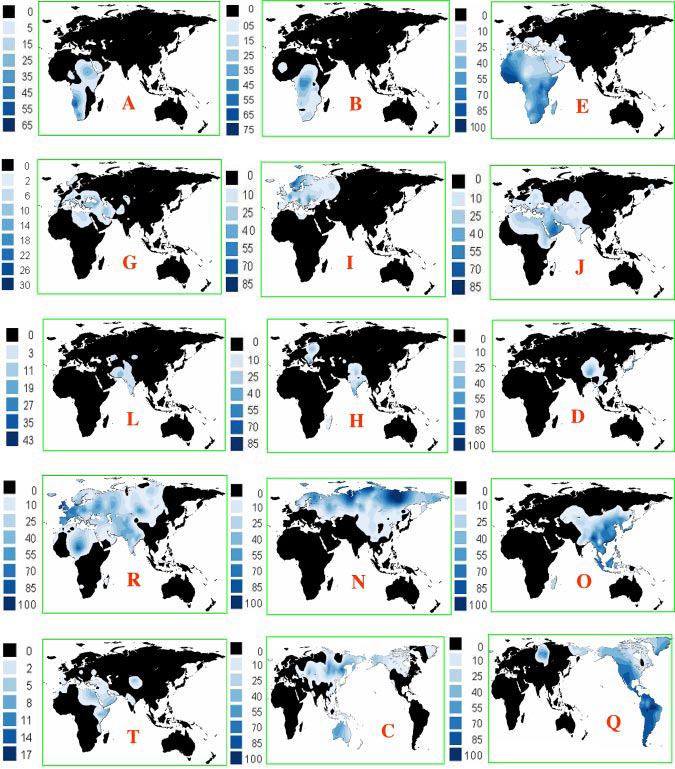
Y chromosome haplogroup geographical distribution map

Phylogenetic relationships of the 20 major Y chromosome haplogroups

Haplogroup R and subclades frequency distribution

Link
Subscribe to:
Posts (Atom)

 Posts
Posts

